Friday, July 31, 2015

Google: We Don't Give Advice On Algorithmic Penalties


Google's John Mueller in this mornings Google Hangout said at the 4:37 mark into the video that Google doesn't tend to give advice around algorithms.
Yes, for manual actions, they try to give specific advice. But when it comes to being hit by Panda or Penguin or any search quality algorithm, Google says they tend not to give advice.
He said in response to being asked for advice:
I don’t know if I can give you specific examples there. We tend not to do that for algorithms when they review the site. Unless it is something really obvious that we can point out. Where we can say well, your home page has hidden text or something like that. For technical reasons that might be something where we can give examples. With search quality algorithms that is usually where we can’t give any specific examples from our side.


Here is the video clip:


From experience watching Google help webmasters, this is accurate. Truth is, I think it is often very hard for Googler's like John Mueller to find an example of why a site may be hit by Panda. Often you see him struggle with it when he is asked about specific cases.

Forum discussion at Google+.

Author 
By SEO Edmonton

How Do You Rank on Google?


Google's algorithms are better-focused than ever, according to a new study from Searchmetrics.

In its fourth annual Google ranking factors study, the enterprise platform looked at the top 30 search results for 10,000 keywords and 300,000 websites on Google. According to Marcus Tober, founder and chief technology officer at Searchmetrics, the findings simply confirm the current trends.

"Understanding user intention and creating unique, relevant content is more vital than ever before," Tober says. "It is also visible that backlinks are continuing to decrease in relevance. Looking ahead, as the proportion of search queries from mobile  devices continues to grow, it will be interesting to see what effect this has on the rankings."

Some factors Searchmetrics saw positively affecting the rankings include mobile-friendliness; social signals, such as Facebook likes and Tweets; and backlinks, though the latter will likely decrease in importance. The study focuses on three other main areas:  

1. Technical

Technical factors are still most important when it comes to ranking in Google. Compared with last year, the search volume of domain names has increased strongly. While brands often rank higher because of their inherent visibility, brand searches, with or without extra keywords, also influence non-branded searches.

Other positive ranking factors include a domain's SEO visibility; the frequency of H2 tags, in addition to H1 and meta description; a strong-but-short URL, which is worth thousands of keywords; and site speed. In addition, HTTPS encryption, which Searchmetrics included in its analysis for the first time, also impacts sites positively, though it's not necessary for sites that don't deal in sensitive data.

On the other hand, Keyword domains are no longer the strong ranking factor they once were. In 2014, 9 percent of the URLs in the top 30 included a keyword in their domain, a number that decreased to 6 percent this year. The proportion of pages using Flash is also significantly lower in the first two SERPs on both desktop and mobile.

2. User Experience

The internal link structure is important for both the crawlability of the Google bot and the user experience - CTR, bounce rate and time spent on site are three factors in ranking, after all. Last year, there were 131 internal links within the top 10 rankings; this year, there are 150. The same is true for optimization, which also includes factors such as responsive design, font size, and interactive elements. Bulleted lists also seem to be ranking factors, as they appear in half of the second-ranked sites and 40 percent in the top 30.

However, while the number of images helps rankings, the number of ranking sites with integrated videos has fallen from 2014. As of last summer, Google only plays video thumbnails in the SERPs; the dominance of YouTube also makes it difficult to rank. Searchmetrics also found that a large number of ads hurts ranking. Pages other than the first two search result spots, which are generally a brand page and Wikipedia, have an AdSense percentage of more than 10.

3. Content

While the content from the top 30 ranked pages has become more extensive - the word count for the top 10 pages averages 1,285, 25 percent higher than last year - less complex and more holistic, with more sites using proof terms and relevant terms.

Just as with the technical aspect of websites, keywords have become less important within content as well. Searchmetrics found that the percentage of pages that have the keyword they want to rank for as an external link's anchor has fallen, especially toward the top of the rankings. However, keywords are much more important within internal links.

The full study can be found here.

Author: 
By SEO Edmonton

Thursday, July 30, 2015

How Your Content Strategy Should Affect Your SEO Expectations


If I had a dollar for every time someone asked me if I could get them a No. 1 Google ranking for a specific non-branded, hyper-competitive keyword, I would be rich. If I had a dollar for the number of times the people asking me that question actually had the content to warrant such a listing, I would be poor.

Many digital marketing folks, especially in enterprise B2B companies, don't quite understand the relationship between content and SEO. It's long been said in SEO circles that content is king.
However, some SEO folks would argue that links or social engagement is king, and that content is the primary driver of links and social success. There are valid arguments on all sides of that meaningless debate, but the point that often gets lost is that creating the best user experience for the vast majority of people searching for a specific keyword is probably what's going to get you ranked consistently for that keyword.

A content strategy that supports that bigger vision is typically different than the customer-focused strategies most B2B companies use. Many people over the years have told me, "Our company is the market leader for this term! We should be No. 1!" That is often true for products or services that are relevant to the keyword phrase they are targeting. It is true that brand recognition - and certainly the links that typically accompany successful brands - make it more likely that a company will rank well for relevant terms, but the fact remains that brand authority is not always enough to guarantee a top ranking for a particular keyword.

I would argue that that is less likely to be the case in the future, as search algorithms become more sophisticated at measuring user satisfaction and engagement. Links are still a pretty good reflection of quality so they carry a lot of weight in most search engine algorithms, particularly Google. However, there is no doubt that the ever-increasing weight of other signals designed to reward good user experience will ensure that going forward, if you don't deliver the content that people want, your company won't be found for that keyword.

I'm sure many people reading this will say, "Hey, Catfish, this is old news." But I would argue that it is still one of the biggest issues facing companies, especially B2B companies, today, as they spend a lot of money on SEO in hopes of attaining top 10 listings for their target keywords. I often see companies primarily producing marketing content that they think will help sell their products and then expecting that content to rank on the first page of Google for their primary keyword. If you look at it from the big picture, there are very few companies producing marketing content so compelling for the average user - who is searching on a general, non-brand keyword - that it truly deserves to be called one of the top three resources on the Internet for that term.

Take the phrase "Database management," for example. Most B2B companies targeting this phrase have content that speaks to their service offerings, their products, their competitive differentiators and possibly, some thought leadership content that speaks to current events or where they see the future of database management going. They may even have a definition page called something along the lines of, "What is Database Management?" specifically to target that phrase, not complement any other content. All of these things are a good start to ranking highly for the term "database management,: but oftentimes, those content segments still serve a relatively limited audience, given the number of different personas who are using that search term.

If you are truly trying to create a site that's a top three resource for a term like "database management," you will need to become an authoritative hub for all things database management. This means that the page that will most likely be ranking for this keyword will be less about selling products or services and more about meeting the needs of the average user doing the query. It means that this page will typically be a top level navigation page with links to deep content around all things database management. A content strategy like this certainly includes links to your product and service pages, but it also includes links to your thought leadership content; your definition page; your take on the state of the industry, recent industry events that will affect the entire industry, and common problems facing folks in the industry that your offering helps solve. You should also include answers to common questions that people - all kinds, not just your target customers - have with the term.

It will certainly be the top level node in some of the most comprehensive information on the subject that can be found anywhere on the Internet. It will also be easy to use with careful thought into the user journeys of all potential visitors. It will load quickly and be mobile friendly. In short, the content emphasis shifts slightly away from marketing and selling, and more to education, thought leadership and the engagement of as many different personas who might be using this keyword query as possible. In other words, it should truly be one of the best resources online for the entire audience of folks who typically do searches for this keyword phrase.

Most companies would do better to focus on casting a wide net on longer tail, more specific keyword phrases that are part of larger conversations around topics that contain many keywords. SEO success should be measured in traffic and conversions, as opposed to rankings for vanity keywords, which often convert at a lower rate because of how generic they are. Chasing these kinds of fat head keywords makes sense for some, but certainly not most, brands.

Of course, explaining this strategy to a CMO can be tricky when the company has prioritized ranking for certain keywords as part of their KPI set. In those cases, don't tell folks they shouldn't focus on rankings for specific keywords for their primary SEO success KPIs. Instead, you can paint the picture of what deserving to rank for such a keyword entails and what the commitment would have to be, in order to have a realistic expectation of being successful.

Wednesday, July 29, 2015

The Value of Links


  As an emerging industry, SEO is a field ripe for new college graduates, individuals looking to enhance their career skills, and those with a background in computer science, marketing, advertising, journalism, and other parallel careers. Everyday more and more people pour into the search industry.

In 2014 LinkedIn put SEO at number five for the hottest skills to get hired. Many jump at the opportunity to learn SEO, especially in conjunction with other skills. SEO is also a very practical skill to learn – search accounts for such a large percentage of Internet traffic that anyone with a website needs to learn SEO best practices if they take their site and traffic seriously.

The first thing a new SEO must learn is how Google operates. This means learning the value of links in search.

Google began by using links as the core of its search algorithm, which powers its results. This use of links made Google better than any other search engine available at the time. Google’s recognition of the value of links is what propelled its initial success.


But there’s a problem with the way many SEOs learn about Google and links. Learning that links are valuable because of search colors their perspective, and makes them see links as important only to SEO.

This valuation of links for search, and search alone, is putting the cart before the horse. Despite Google’s influence online, they do not yet control the shape of the Web.

  Links aren’t valuable because of Google; Google is valuable because of its use of links.

Perhaps this is overstating it – there’s no doubt that links serve a critical function in search engine optimization. All search engines use links as a signal of relevance, authority, and trust. Even Yandex has reversed its position, adding links back into the algorithm for the narrow segment it were previously removed (commercial terms for the Moscow locality).

But to think, as many new SEOs do, that the sole reason links are valuable is because of search, is flat wrong.

Links served a critical function long before Google existed, and will continue to have value online whether or not Google chooses to use links in its algorithm.

Links are critical to the function of the Web, marketing, SEO, websites, and humans.


Links Are a Fundamental Element of the World Wide Web


An oft-overlooked fact is that the Web as we know it couldn’t exist without links.
Links piece together the Web – it’s why we call it a "web" in the first place. Links are the strands that connect all the millions of pieces (websites) together.
There are essentially three ways to navigate the Web:
  1. Type the exact page URL into your browser’s address bar.
  2. Bookmark a page so you can return again.
  3. Follow a link from one page to another.
Method one — typing the full URL path — is next to impossible for anything beyond the homepage of a domain you’re extremely familiar with. Facebook.com and Google.com are the classic examples. Once there, you would use links to navigate to specific pages.

Method two — bookmarks — only work if you’ve previously visited a page. Even then, bookmarks become extremely unwieldy if you bookmark every page you wish to visit again.

Method three — links — is by far the most common method of navigating the Web.

Links are also critical to navigating the various pages of a website. Facebook would be an impossible mess without strong site architecture and UX, both of which are dependent upon links.


Links Are Critical to Discovering New Sites


Exploration of the Web is also wholly reliant upon links.
Here’s how I explore the Web:
  1. Search:  I use search to find specific sites containing specific information. Search returns a list of links (along with to pages they believe relevant to my query. Trust is implicit in search, and relevance is determined by the searcher based upon the title, meta description, brand/site familiarity.

  2. Social:  Social media allows me to see what sites, pages, and content my friends recommend via links shared. I trust the links based upon how much I trust my friends, and click based upon the context surrounding the link.

  3. Sites I Trust: Reddit.com is a perfect example of a site I trust which I use to further explore the Web. Reddit users submit links to various subreddits — essentially subcategory pages — they think other Redditors will like. Redditors then upvote or downvote that link, establishing trust.Reddit is essentially an aggregation of other Web pages (their tagline is “the front page of the Internet") that Redditors think interesting, entertaining, or otherwise worth visiting. Link trust is based upon the trust of the community.
Every single one of these methods of exploring the w=Web is wholly reliant upon links.
Without links, the Internet would be entirely unnavigable. The Web runs on links.


Links Are Extremely Valuable in Marketing


All links are a type of exposure. Whenever you encounter a link on a website, another human is effectively saying, "I believe this page is worth your time, or is something you need to see."
That’s a strong vote of confidence.

This confidence is inherently understood as trust. If a website links to another website, it’s understood as a willing association. Of course context matters, and helps guide trust – but more often than not that link is an expression of value.

People who trust a website will transfer this trust to the linked website. There’s an implication of authority and respect with a link.

And since awareness is the main goal of all marketing, links play a critical role in much of online marketing. Yes, links matter to SEO. But links also matter beyond SEO.

Links build exposure, branding, relationships, authority, engagement, and even traffic outside of search.

Links literally direct visitors from another website. Anytime you have a backlink on another website, there’s an opportunity for exposure and traffic.

A link is a citation, mention, and direct navigation all rolled into one.

There is no parallel in offline marketing. There’s nothing in traditional marketing that makes arriving at a business as easy as the click of a mouse.


Links Remain Critical to Search Visibility


Since Google first used links as the core of its algorithm, and subsequently cornered the search market, links have been vital to SEO success.

This remains true today, despite the introduction of hundreds of other signals. Links remain critical to improve your organic search traffic.

Every SEO has witnessed the power of links in improving search visibility. Serious studies from both Moz and Searchmetrics confirm this. It’s well understood that links are a primary ranking factor.

Furthermore, Google continues to stand behind links as a signal in search.
There can be no doubt about the efficacy of links in search.


Shouldn’t the Value of Links Be Obvious?


With links playing such a critical role on the Web, it seems the value of links should be obvious.
Yet if you stop a random person on the street and ask them why links are valuable, they’ll likely stumble through an explanation. Clients often wonder about the value of links, needing further education. Even other marketers don’t always respect the value of links online.

Marketers are a jaded bunch. SEOs perhaps the worst of the lot. We’ve experienced and seen the manipulation that can and does happen time over time, until we forget that not everything is manipulation.

Furthermore, there’s a strong tendency in the SEO industry to forget the power of links beyond search. We can have extreme tunnel vision regarding search. We become convinced Google controls the fate of the Web, and are quick to think the sky is falling.

As SEOs we like to continually look to the future and question what we know. We’re constantly challenging one another. But this can be taken too far.

Will links continue to remain critical to search? Not according to some.
Which is why it’s so important to understand the value of a link – not just for search, but for the Web as a whole.

When you look at the Web from a search-only perspective, which is entirely too tempting as an SEO, you actually blind yourself to the Web as it is, and the value of links.

Links aren’t valuable because Google’s made them so; links are valuable in and of themselves. In fact, the reverse argument is more correct – Google’s valuable because is realized the value of links.

Author  
By SEO Edmonton

Tuesday, July 28, 2015

Google Warning : Googlebot Cannot Access CSS & JavaScript


Google is now sending out a rush of new warnings via Google Search Console, formerly Google Webmaster Tools to notify webmasters that GoogleBot cannot access their CSS and JS (JavaScript) files on their web sites.

Michael Gray first notified me directly via Twitter and I planned on covering it tomorrow, but it seems Google is sending these warnings out at a rapid pace. Tons of webmasters are concerned after receiving these warnings.
Here is a picture:
Google Warning: Googlebot Cannot Access CSS & JS

Google has been telling webmasters to not block CSS & JavaScript for years and years. Here is Matt Cutts in 2012 telling webmasters not to block it. The webmaster guidelines were updated to say not to block them. The new fetch and render tool warns you when you block CSS and JavaScript. We also know, Google renders the page as a user would see it these days, so blocking CSS/JS can impact that big time.


It seems like Google is sending these notices out in mass quantity now. The message reads:

Google systems have recently detected an issue with your homepage that affects how well our algorithms render and index your content. Specifically, Googlebot cannot access your JavaScript and/or CSS files because of restrictions in your robots.txt file. These files help Google understand that your website works properly so blocking access to these assets can result in suboptimal rankings.

This is not a penalty notification, but a warning that if Google cannot see your whole site, it may result in poorer rankings.

If you get this message, talk to your developers and discuss what you can do, if you need to do anything. Use the fetch and render tool to diagnosis the issue deeper as well.

Many WordPress sites are getting this notification because their /wp-includes/ folder is blocked by robots.txt. Plus there are many popular CMS solutions that block their include files by default.

Forum discussion at Twitter.

Author: 
By SEO Edmonton


Google : How to Protect Your Site from Getting Hacked


Google continued its #NoHacked campaign today with some tips on how to prevent sites from getting hacked.

This past year saw a 180% increase in the number of sites getting hacked, Google says, and in order to ensure your site isn’t targeted the company recommends taking the following precautions.


Password Security

By now it’s practically common knowledge that a strong password contains a combination of letters, numbers, and symbols — but Google says there’s more to it than that.

Length is also a factor, the longer the password is the harder it is to guess. It’s also recommended to avoid using the same password across multiple services.

In addition, Google recommends turning on 2-factor authentication, which can significantly strengthen your account’s security.


Software Updates

Keep your site’s software up to date, Google says, because outdated software is one of the most common ways a hacker can take control of your site.

This includes keeping your web server software patched and your CMS’s plugins and add-ons updated.


Hosting Provider

If you use a hosting provider, Google recommends you contact them to see if they offer on-demand support for dealing with issues related to hacked sites.

If you manage your own server, Google says you better be prepared to deal with any complex security issues that might arise.


Google Services

Google offers a number of services that notify you if your site is compromised. Signing up for Google Search Console (formerly Webmaster Tools) is one of the most obvious recommendations since it’s Google’s direct connection to site owners.

In addition, Google suggests setting up Google Alerts to notify you of suspicious results for your site:
“For example, if you run a site selling pet accessories called www.example.com, you can set up an alert for [site:example.com cheap software] to alert you if any hacked content about cheap software suddenly starts appearing on your site.”

Setting up alerts for spammy terms following the method described above is also recommended.

Author: Matt Southern
By SEO Edmonton

How Google’s New Mobile Ad Units Will Increase Your Mobile Conversions


On May 5th during the long-awaited Google AdWords LiveStream at SMX, Google’s VP of Product Management Jerry Dischler took the stage to reveal some exciting and mix-reviewed innovations the team has released (or plans to release) with hopes of improving the search experience for users and advertisers.

One of the most exciting updates? The new mobile ad units! Google revealed that mobile searches have finally surpassed desktop, so naturally they’ve been pushing mobile optimization for advertisers through product innovations.

But, there’s one headache inducing problem with mobile advertising – we kind of suck at it! I apologize for being blunt, but truly converting mobile visitors has proved to be a challenge for advertisers across multiple industries.

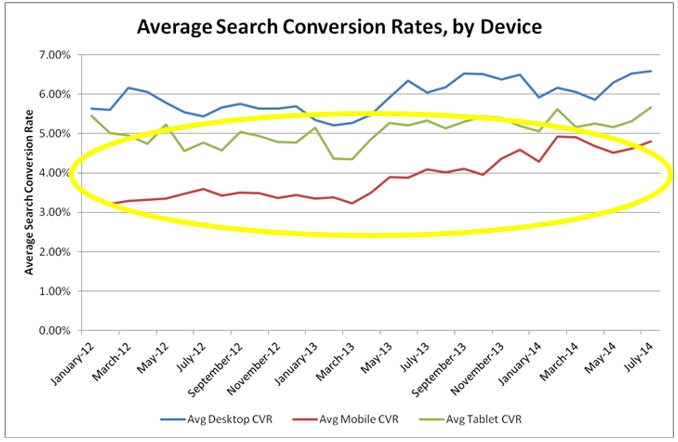
Just check out the graph below from a WordStream study proving that mobile conversions fall far behind conversions occurring on desktops and tablets:

new-mobile-ad-units-data


Pathetic!

The biggest problem is that advertisers are treating their mobile ads the same as their desktop ads, when in reality mobile behavior is vastly different. Mobile searchers are on-the-go, multi-tasking, commuting, and easily distracted creatures. In contrast, desktop searchers are more civil, focused, and inclined to conduct research.

Think about it. When you’re cooking pasta while browsing your phone for new sandals and you notice the water boiling over, are you going to ignore it and proceed with your shopping? Absolutely not. Advertisers need to realize mobile searchers are not different people, but people in a different state of mind.

So, what has Google done to address this?

They’ve introduced new mobile ad formats for four of the largest industries advertising on Google including travel, finance, automotive, and shopping. Naturally, non-included industry advertisers felt discouraged upon these announcements. Luckily, Jerry confirmed at SMX Advanced in Seattle that Google intends to scale these new mobile ad units for multiple industries in the coming months.

“When session lengths are compressed as they are on mobile, we need to drive people to answers more quickly,” Dischler said. “On mobile, people also expect more rich content. So we’re going to build products that work well on mobile first. For each vertical, we’d like to create a template that will lead to an answer.” So take a breather, Google has not forgotten about you!
Now let’s take a look into some of the most innovative features these new ad formats have to offer.


#1: Mobile Ads are Becoming More Visually Interactive

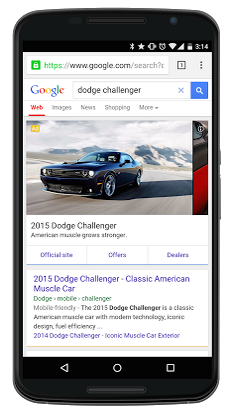
Google recently announced carousel ads, which are a set of images that you can scroll through (similar to a catalog) directly on the SERPs. They’re engaging, interactive, scream ‘mobile-friendly!’ due to the touch-screen element, and allow the searcher to browse before clicking, which is beneficial for both the searcher and the advertiser.
new-mobile-ad-units-example

Currently, this feature is for automotive advertisers only. Around 50% of searchers in the automotive industry occur on Google, so they’ve decided to prioritize these formats for this visual and research-heavy industry first.

I suspect that these formats will become available for advertisers in various industries because, let’s face it, imagery is important to both the user and advertiser, so Google withdrawing the ability so see images within ads on the SERPs could lead to fewer mobile clicks and more frustrated spenders.


#2: Easily Compare & Read Product Reviews on the SERPs

Do you remember the last time you bought a car? You hopped online, did a search including the ‘must-have’ terms to find an affordable and practical vehicle, and hit “Buy now”, right?

Not exactly. You likely spent months comparing models, conducting research, reading reviews, etc.
Google understands how people shop. Searchers want to make informed decisions before purchasing. Whether it be booking a hotel room or signing up for a new credit card, a searcher is never going to choose the first thing they see. They also understand that, on mobile, the chances of visiting a bunch of websites to get additional information on various brands are pretty much nonexistent. Mobile searchers don’t have the patience, time, or attention span for this kind of investigation.

This is why Google introduced Google Compare in March to help shoppers compare car insurance directly through the SERPs. “Whether you’re a national insurance provider or one local to California, people searching  for car insurance on their phone or computer can find you along with an apples-to-apples comparison of other providers – all in as little as 5 minutes,” says the Google AdWords blog. “You can highlight what makes your business unique, whether that’s an ‘A’ rating in customer service or better discounts for safe drivers.”

During the Livestream, Dischler announced Google Compare will be coming for mortgage providers and credit card companies, which leads to the suspicion that Google Compare is going to be available to compare several other products across a range of industries in the future. With the new hotel ad formats, searchers are also easily able to compare hotel locations, reviews, and rates side-by-side.

In addition to the ability to compare products on the SERPs, Google is also integrating more review information into ads. Approximately 88% of consumers trust online reviews as much as personal recommendations according to BrightLocal, so Google is making it easier for mobile searchers to see reviews directly on the SERPs.


#3: Revamp of Dynamic Search Ads to Make Your Life Easier

Dynamic search ads previously just inserted a search query into the headline of your ad in the hopes of boosting relevancy and CTRs. Although this capability worked wonders for some advertisers, others (like eBay) misused the functionality leading to embarrassing results.

The problem with targeting searchers with keywords is that 15% of Google searches are completely unique and have never been searched for before, therefore chasing mobile specific keywords is a fool’s game. Luckily, Google has made huge strides with a complete revamp of Dynamic Search Ads providing a much higher level of transparency and lower level of keyword management.

So, how do these new DKIs work exactly? Google’s web crawling technology scrapes through the content of your site, and then organizes your site into categories, which then match to relevant queries and ads and direct to the most relevant landing page. Why I already love these new DKIs: it gives the searcher a clean, easy, and relevant experience, and takes the daunting task of keyword management and set-up out of the equation for the advertiser.

Also, you don’t need to break a sweat about Google running the show because you will still have the ability to make adjustments on categories, targeted searches, ad text, etc.


#4: The Ability to Buy, Book, & Act Directly Through the SERPs

Mobile searchers are far too busy to visit a bunch of websites. They want to hop on Google, get an answer or complete an action, without having to go through a site full of hurdles and pages to get the end result. With additional hurdles on mobile comes a lack of motivation from searchers. “Eh, I guess I don’t really need that,” or “I’ll do it later,” the searcher thinks, and then sayonara to that on-the-brink conversion.

This is why new mobile ad formats are going to allow searchers to do more, faster. Google recently confirmed that the buy button is real, making it easier for shoppers to buy on-the-go. They’ve also revealed the ability to complete other actions more easily, like booking a hotel or flight with the click of a button, on the relevant check-out page. This will be a huge advantage for advertisers to keep the motivation of mobile searchers high and increase conversions.

I’m thrilled about these new mobile ad formats and am confident that mobile conversion increase potential is set high for advertisers.

What are your thoughts on these new mobile ad formats?

Author: Margot da Cunha
By SEO Edmonton